How to Integrate Peer-Supported Recovery Housing With New Prop 1 Care Communities
With the July 1, 2026, shift toward the Behavioral Health Community Supports (BHCS) framework fast approaching, San Diego’s behavioral health landscape is undergoing its most significant transformation in decades. Driven by Proposition 1 and the restructuring of the Behavioral Health Services Act (BHSA), the focus has shifted decisively toward "Care Communities": integrated campuses designed to co-locate crisis stabilization, clinical treatment, and social rehabilitation.
For social workers, hospital discharge planners, and program directors, these new facilities represent a powerful tool for stabilizing high-acuity patients. However, a clinical facility is only a "stepping stone," not a destination. To ensure lasting success, these clinical Care Communities must be seamlessly integrated with peer-supported recovery housing.
At Empowering Potential Housing, we serve as the critical bridge between the intensive clinical oversight of Prop 1 facilities and the long-term community integration required for sustained sobriety. This guide explores how to effectively navigate this integration to provide your clients with a seamless continuum of care.
Understanding the "Care Community" Model Under Prop 1
The new Prop 1 framework emphasizes that housing is a core component of treatment, not a standalone service. In San Diego, this is manifesting in large-scale projects like the Midway District’s Behavioral Health Wellness Campus. These campuses are designed to provide:
* **Crisis Stabilization:** Immediate support for those in acute mental health or substance use crises.
* **Residential Treatment:** 24/7 medically monitored environments for high-need individuals.
* **Social Rehabilitation:** Peer-led support within a "home-like" clinical setting.
While these facilities are essential for stabilizing individuals experiencing homelessness or severe behavioral health challenges, they are inherently transitional. The "Care Community" provides the clinical foundation, but the recovery residence provides the "playground" where real-world accountability is practiced.
Why Peer Support is the Glue of the Continuum
Clinical care can treat the symptoms of addiction and mental health disorders, but it often struggles to address the isolation and lack of purpose that lead to relapse. This is where the "lived experience" model becomes indispensable.
Peer-supported recovery housing operates on the principle that those who have walked the path of recovery are best equipped to guide others through it. At Empowering Potential Housing, our mentorship and peer-based community focus on several key pillars:
1. Accountability Over Comfort: Residents are expected to engage in a recovery program of their choice, whether that is AA, NA, SMART Recovery, or Celebrate Recovery. We prioritize the discipline of daily check-ins and house standards.
2. Changing Playmates and Playgrounds: We provide a curated environment that removes triggers and replaces them with a community of peers striving for the same goals.
3. Stability Through Structure: Recovery is difficult without a stable foundation.
Bridging the Gap: From Clinical to Residential
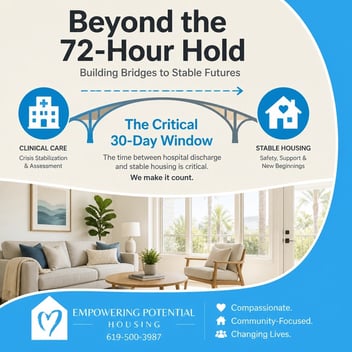
For those early in recovery transition from a Prop 1 Care Community to a recovery residence is a high-risk period. To mitigate this, integration must be proactive.
Step 1: Early Identification
Don’t wait for discharge to start the housing conversation. As soon as a client is stabilized within a Prop 1 clinical setting, their long-term housing plan should be initiated. Identify clients who are ready for a higher degree of autonomy but still require the "guardrails" of a structured environment.
Step 2: Utilizing Medical Respite for Complex Transitions
Many clients leaving Prop 1 facilities may still require daily wellness check-ins or clinical oversight before they are ready for a traditional recovery residence. Our Medical Respite services are specifically designed for Medi-Cal members experiencing homelessness who need a safe place to heal after a hospital or SNF stay. This serves as an intermediate step between the hospital and the permanent recovery home.
Step 3: Simplifying the Application Process
Case managers are often bogged down by paperwork. We have streamlined our intake to be as accessible as possible. We believe that everyone deserves a "clean slate" to build their new life.
The Financial Reality of Long-Term Recovery
Prop 1 and CalAIM have opened new doors for funding, but affordability remains the primary hurdle for residents once they transition out of fully subsidized clinical settings.
A good sober living home must be sustainable for the resident. Our recovery residences in San Diego are priced at a consistent $1,000 per month, which includes all utilities, internet, and a fully furnished living space. This predictability allows residents to focus on finding employment and building their savings without the fear of hidden costs.
For social workers, this means you can place a client with the confidence that they are moving into a high-standard, accredited recovery environment that fits within a standard SSI or entry-level employment budget.
Accountability: The Difference Between a Good and Bad Sober Living
As the influx of Prop 1 funding increases the number of "beds" in San Diego, the quality of those beds will vary. A "bad sober living" is simply a place to sleep; a "good sober living" is a community that demands growth.
Social workers must look for homes that enforce:
Drug and Alcohol-Free Environments: Verified through regular, randomized testing.
Active Participation: Residents must be "working a program" and contributing to the house community.
Peer Mentorship: On-site support from those with lived experience who can identify early signs of relapse and provide redirection.
At Empowering Potential Housing, we don't just provide a roof; we provide a "stable foundation for long-term recovery." We maintain the highest residential standards because we know that discipline is a form of care.
Strategic Partnerships for San Diego Social Workers and Case Managers
The 7/1/2026 shift is not just a policy change; it’s an opportunity to rebuild the continuum of care for San Diego’s most vulnerable populations. By integrating the clinical power of Prop 1 Care Communities with the community-based power of peer-supported recovery housing, we can create a system where no one falls through the cracks.
Empowering Potential Housing is ready to be your partner in this new era. Whether you are discharging a patient from a hospital, a skilled nursing facility, or a new Prop 1 wellness campus, we offer the structured, affordable, and supportive environment your clients need to succeed.
Let’s Build a Stable Foundation Together
If you are a social worker or program director looking for a reliable housing partner in San Diego, we are here to help. Our team understands the nuances of the BHCS shift and the complexities of hospital discharge planning.
**Contact Empowering Potential Housing today to discuss a referral or learn more about our current openings.**
**Phone: (619)500-3987
**Website: empoweringpotentialhousing.com