Looking For Housing Stability? Here Are 10 Things You Should Know About the 2027 CalAIM Renewal
For individuals navigating the journey from homelessness or hospitalization into long-term recovery, housing stability is more than just a roof: it is the foundation of a new life. In California, the primary engine driving this stability for the most vulnerable populations is **CalAIM (California Advancing and Innovating Medi-Cal)**.
As we move toward the next major milestone in this initiative, the **2027 CalAIM Renewal**, it is essential for social workers, healthcare providers, and individuals in recovery to understand how the landscape is shifting. This renewal isn't just a paperwork update; it represents a significant evolution in how housing-related supports, medical respite, and recovery residences are funded and managed.
At Empowering Potential Housing, we believe that informed residents and partners are successful ones. Stability requires structure, and structure starts with understanding the rules of the game. Here are the 10 key things you need to know about the 2027 CalAIM renewal and what it means for your housing journey.
1. From "Waiver" to Permanence: The Shift to ILOS
Historically, many of the housing supports we rely on were funded through temporary federal "waivers." The 2027 renewal marks a strategic move by the Department of Health Care Services (DHCS) to transition many **Community Supports (CS)** into a more permanent status known as **"In Lieu of Services" (ILOS)**.
What does this mean for you? It means that services like medical respite and housing navigation are becoming standard parts of the Medi-Cal managed care delivery system. They are no longer "pilot programs" that might disappear overnight; they are being woven into the permanent fabric of California’s healthcare safety net.
2. A New Unified Model for Recuperative Care
One of the most significant changes in the 2027 renewal is the consolidation of medical respite services. Currently, "Recuperative Care" and "Short-Term Post-Hospitalization Housing" (STPHH) often overlap, creating confusion for hospital social workers trying to place fragile patients.
Starting January 1, 2027, DHCS proposes a single, unified **Recuperative Care model**. This model will incorporate the clinical oversight and daily wellness check-ins necessary for those who are too ill to recover on the street but not sick enough to stay in a hospital bed. This streamlined approach is designed to provide a more predictable "stepping stone" for those transitioning out of acute care.
3. The Sunsetting of Standalone STPHH
As part of the move toward the unified model mentioned above, standalone **Short-Term Post-Hospitalization Housing (STPHH)** will be sunset as a separate category. While the *function* of this housing will remain, it will be absorbed into the expanded Recuperative Care benefit.
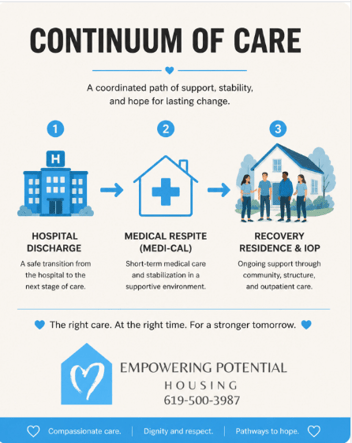
For providers and social workers, this means the referral process will become more standardized. You won't have to choose between two similar-sounding programs; you will simply refer to the unified recuperative care system, which will handle the transition into stable recovery housing once the medical crisis has stabilized.
4. Transitional Rent: The Critical 6-Month Window
The inclusion of **Transitional Rent** is perhaps the most exciting: and most scrutinized: development. Mandatory for managed care plans by January 1, 2026, this benefit allows for up to six months of rent payments for eligible individuals transitioning from institutional settings or homelessness into stable housing.
The 2027 renewal aims to protect this benefit while navigating federal restrictions. For a self-pay individual or a resident in one of our homes, this can bridge the gap while they secure employment or disability benefits. It is a tool for accountability, providing the breathing room needed to focus on "changing playmates and playgrounds" without the immediate threat of eviction.
5. Federal Scrutiny on "Room and Board"
It is important to be realistic: the federal government is tightening the reins on how Medicaid dollars are used for "room and board." While California is fighting to keep rent supports in place, the 2027 renewal will likely come with stricter eligibility requirements.
Federal regulators are increasingly looking for "medical necessity" in housing. This is why our structured wellness check-ins and clinical oversight are so vital. To maintain funding, housing must be more than just a bed; it must be a recovery-oriented environment that actively supports a person's health outcomes.
6. ECM as the Anchor for Housing Stability
**Enhanced Care Management (ECM)** remains the anchor of the CalAIM strategy. In the 2027 landscape, your ECM provider will be your primary advocate. They are responsible for coordinating the "Housing Trio": Transition, Deposits, and Tenancy Sustaining Services.
Stable housing is rarely achieved alone. The renewal reinforces the role of the lead care manager as the person who ensures the resident doesn't fall through the cracks during the transition from a hospital discharge to a recovery residence.
7. Standardizing the "Housing Trio"
If you have worked with CalAIM in the past, you may have noticed that different counties and different health plans offer different levels of support. One of the goals of the 2027 renewal is **standardization**.
DHCS is pushing for a more uniform experience across the state. Whether you are in San Diego or Sacramento, the Housing Trio (Navigation, Deposits, and Tenancy support) should look and feel the same. This predictability is essential for SUD (Substance Use Disorder) programs looking to partner with housing providers like Empowering Potential Housing.
8. Focus on Performance-Based Outcomes
The "honeymoon phase" of CalAIM implementation is ending. Moving into 2027, the focus is shifting toward **outcomes**. Managed Care Plans (MCPs) will be looking at data: Did the resident stay housed? Did their ER visits decrease? Did they remain engaged in their recovery program?
At our residences, we emphasize accountability because it drives these results. A "good" sober living environment isn't just one that is comfortable; it is one that produces measurable stability. The renewal will reward programs that can prove they are helping residents achieve "lasting recovery."
9. Increased Integration for SUD and Mental Health
The 2027 renewal doubles down on the integration of behavioral health and physical health. For individuals in recovery, this means that their housing stability plan will be more closely tied to their clinical treatment plan.
We support a community-based approach where residents can choose their own path: whether that is AA, NA, SMART Recovery, or Celebrate Recovery. The 2027 changes make it easier for these diverse recovery paths to be recognized as part of a resident's overall "health and wellness" strategy, which is often a requirement for staying in CalAIM-funded housing.
10. Health Equity and Targeted Outreach
Finally, the renewal places a heavy emphasis on **Health Equity**. This means targeting resources toward populations that have historically been underserved, including the justice-involved population and those with dual diagnoses (SUD and mental health).
Housing stability should not be a lottery. The 2027 renewal aims to ensure that those with the highest needs: and the most frequent "flares of illness": are prioritized for medical respite and transitional housing.
Moving Toward a Stable Future
The 2027 CalAIM Renewal represents a maturation of California’s commitment to housing as a health intervention. While the rules are becoming more complex, the goal remains the same: to provide a structured, supportive environment where individuals can rebuild their lives.
For social workers and SUD programs, this is a call to action to document your successes and strengthen your partnerships with high-standard housing providers. For individuals seeking a place to live, it is a reminder that while the system offers support, the foundation of stability is built through your own personal growth and accountability.
We Are Here to Help
Navigating the world of Medi-Cal, CalAIM, and recovery housing can be overwhelming. Whether you are a social worker looking for a placement or an individual ready to take the next step in your recovery journey, Empowering Potential Housing is here to guide you.
Our homes in San Diego offer affordable ($1000/month), no-credit-check recovery environments that include all utilities and high-speed internet. We are proud partners in the CalAIM ecosystem, providing the structure and community needed for long-term success.
**Contact us today at (619) 500-3987 to learn more about our current openings or to discuss how we can support your clients through the 2027 transition.**