Navigating Prop 1: What San Diego Social Workers Need to Know About the 7/1/2026 BHCS Shift
The landscape of behavioral health and housing in California is undergoing its most significant transformation in decades. For social workers, discharge planners, and program directors in San Diego, the passage of Proposition 1 in March 2024 isn't just a policy update: it is a fundamental shift in how we serve our most vulnerable populations.
As we approach the July 1, 2026, implementation of the Behavioral Health Community Supports (BHCS) framework, the "business as usual" approach to hospital discharge and recovery placement is coming to an end. This shift prioritizes one thing above all else: **Housing as a component of healthcare.**
At Empowering Potential Housing, we recognize that these changes can feel overwhelming. However, Prop 1 provides the structural and financial "teeth" needed to finally bridge the gap between acute care and long-term stability. This guide breaks down exactly what San Diego’s professional recovery community needs to know to navigate the 2026 shift.
The Core of Prop 1: Reallocating for Results
Proposition 1 recasts the Mental Health Services Act (MHSA) into the **Behavioral Health Services Act (BHSA)**. While the name change is subtle, the fiscal impact is not. For the first time, counties are mandated to dedicate **30% of their BHSA funds specifically to "Housing Interventions."**
In San Diego, this means millions of dollars are being redirected from general prevention and early intervention programs toward concrete housing supports. This isn't just about building more units; it’s about funding the services that make housing work. Under the new BHSA guidelines, "Housing Interventions" include:
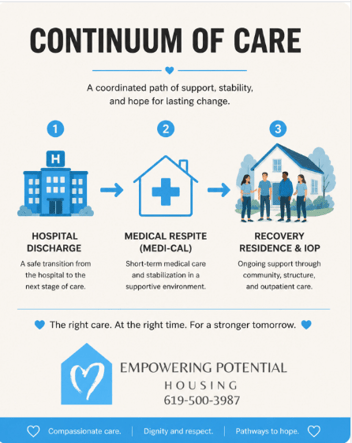
* **Recuperative Care (Medical Respite):** Short-term housing for those exiting hospitals who still require clinical oversight.
* **Recovery Residences:** Structured, peer-supported environments that provide the stability needed to prevent relapse and recidivism.
* **Rental Subsidies:** Direct financial support to keep individuals housed while they engage in treatment.
* **Navigation Services:** Peer-led support to help residents find and maintain long-term housing.
For social workers, this reallocation is a double-edged sword. While some community programs may face cuts, the "housing-first" focus means that when you are looking for a placement for a client in crisis, there will be more dedicated, stable slots available than ever before.
At Empowering Potential Housing, we view these recuperative care beds as the essential first step in a "Housing Trio" strategy. Our medical respite services are specifically designed for Medi-Cal members experiencing homelessness, offering daily wellness check-ins and clinical oversight that many traditional sober living environments lack.
What Happens on 7/1/2026? The BHCS Shift
The date **July 1, 2026**, marks the official start of Behavioral Health Community Supports (BHCS). This is more than a deadline; it is a new ecosystem of care. For social workers, case managers and discharge planners, the BHCS shift will change three primary areas of your daily workflow:
1. Integration of Care
Prop 1 emphasizes that housing and clinical care cannot exist in silos. Starting in 2026, there will be a stronger push for "Full Service Partnerships" (FSPs). This means that a resident in one of our San Diego recovery homes isn't just "living" there: they are part of an integrated network where their housing provider, clinical therapist, and case manager are all communicating.
2. Accountability and Standards
The new funding comes with higher standards. To receive BHSA housing funds, residences must prove they are providing high-quality, recovery-oriented environments. This is where the distinction between a "good sober living" and a "bad sober living" becomes critical. We maintain high standards of residential recovery, focusing on discipline, structure, and peer-based accountability.
Recovery Residences: The "Stepping Stone" to Permanent Stability
In the Prop 1 era, recovery residences are no longer seen as "optional" extras: they are considered essential bridge housing. For many individuals, jumping directly from a hospital or a 30-day rehab into an independent apartment is a recipe for failure. The lack of structure and the isolation of living alone can lead to an immediate return to "old playmates and old playgrounds."
Recovery Residences is a transitional housing option that provides the "middle ground." At Empowering Potential Housing, our monthly rate of $1000 - 1200 monthly includes all utilities and high-speed internet, removing the financial stress that often triggers a relapse. This allows the resident to focus 100% on their long-term recovery goals.
Our homes are not just buildings; they are communities. We offer:
* **Structured Environments:** Clear rules and expectations that foster personal growth.
* **Mentorship:** Peer-based support that provides accountability when the "pink cloud" of early recovery fades.
* **Flexibility:** Whether a resident chooses AA, NA, SMART Recovery, or Refuge Recovery, we provide the stable base they need to succeed in their chosen path.
Why Social Workers Should Partner with EPH Now
The transition to the 7/1/2026 BHCS framework is going to be complex. Social workers in San Diego hospitals and skilled nursing facilities need partners who already speak the language of CalAIM and Prop 1.
Empowering Potential Housing is that partner. We have already integrated the core tenets of the Prop 1 shift into our operations:
* **Medical Respite Oversight:** We provide the wellness check-ins required for medically fragile residents.
* **Accessibility:** Our no-credit-check policy and affordable rates make us an immediate solution for patients with zero assets.
* **Proven Outcomes:** We focus on the "why" and "how" of recovery, ensuring that residents don't just stay sober while they are with us, but build the skills to stay sober for life.
## The Bottom Line
Prop 1 and the 2026 BHCS shift represent a promise to the people of San Diego: that we will no longer accept homelessness as an acceptable outcome for those with behavioral health challenges. As a social worker or discharge planner, you are on the front lines of making this promise a reality.
The road from the hospital bed to a stable home is rarely a straight line. It requires bridges: like recuperative care: and stepping stones: like recovery residences.
If you are looking for a placement for a client or want to learn more about how our homes fit into the new CalAIM and Prop 1 landscape, we are here to help. Let’s work together to ensure that every individual in our community has the foundation they need to reach their full potential.
**Contact Rachel Romero today at (619) 500-3987 to discuss our current availability and how we can support your next discharge plan.**